Friday, February 2, 2024

Memory Problems Anyone?


I wrote the following piece in 1985 when I was a 40-year-old reporter and weekly columnist for the Grants Pass Daily Courier, Southern  Oregon. But I could've written it yesterday! 


Almost 40 when I wrote this.

Trying to Remember Isn't All That Uncommon

I forget things a lot.

I usually remember my name and address and who discovered America and that sort of thing. What I can't recall is what I walked upstairs to get. 

I leave my home office with a mission and moments later, engrossed in an unrelated thought, I've forgotten what it was. 

Or, I go to the grocery store for three items. I memorize the list and recite it on the on the way. I know that if I don't write things down, I'll forget. But just three things? I can handle it. 

But I can't. I meet someone who wants to talk. We ramble on for 10 minutes and POOF, my list is down to two. That third item has disappeared in the mists of short-term memory. I didn't remember the corn until I'm ready to add it to the corn chowder, and we have potato soup instead.

I can recite sonnets from high school but canned corn eludes me. Is this normal?

I'm beginning to think I have a lot of company. In preparing to write this column I asked several people if they consider themselves forgetful. The question produced a lot of rolled-back-of-course-I-do eyeballs, and some embarrassing confessionals. 

One woman not only forgot what she went to the store to buy, but failed to remember that her 9-year-old was with her, and she drove home without him.

Stories like that make me feel somewhat less anxious about dialing a number and forgetting who I called by the time they answer the phone. If I don't recognize the voice, I'm in big trouble. Asking the person you've called who they are is humiliating. 

Another friend frequently forgets which kitchen tool she opened a drawer to retrieve. She has to retrace her steps back to the job at hand to remember, while imitating the cutting or slicing motion of the forgotten tool.

Another woman claims to have a good memory herself, but jokes about her husband who once made three social engagements for the same evening. "He can recite an hour-long poem, but if you send him to the store for milk he'll forget," she relates.  

Forgetfulness apparently has a lot of us worried. It doesn't feel good to make a purposeful trip to the garage or the basement only to stand bewildered, wondering what in the world you went after. 

Or to hide important papers or money, as another woman does, and forget where you put them. 

"It's always a nice surprise to find them later," she says wryly.

Several people I spoke with nervously joked about early-onset Alzheimer's disease.

"Oh, you have it too?" I'd ask, then we'd laugh worried little laughs. It certainly isn't a funny disease, and I don't think any of us really believe we have it, but it somehow springs to mind when one is standing with the refrigerator door agape, searching the shelves for a clue to what one intends to take out. 

Last night I read in Dr. Solomon's column that Alzheimer's can begin in one's thirties....... or was it last week that I read it?


NOTE - Since I wrote the above 40 years ago, I don't believe that my memory is much worse than it was then. Fingers crossed though! Word has it that memory loss is too dang common in the elderly population. But guess what?  Unless I'm looking in a mirror, most of the time I forget that I'm old!


Friday, July 21, 2023

Here we go again! Yahoo!


Our Sprinter van parked on a Baja Peninsula beach in January 2019 represents 
our last serious road trip taking us from our home in Southern Oregon. 

It's time for one more significant road trip adventure before we get too old to drive thousands of miles! And too cranky. 

After a few years of enjoying only quick trips to Reno to see our grandkids growing up, to the Olympic Penisula to witness our son milling lumber to build, with his wife, their home in the forest. And to Bellingham, WA, to visit my elderly aunt and uncle, who, deep into their eighties, are not doing well.

Speaking of the elderly, PK and I are bona fide seniors. PK is on the countdown to 75. Me? Shhh. I have only 18 months before stepping into my eighth decade. Our coming three-months-or-more road trip in our old but spunky 2010 Sprinter van could be the last of our lengthy road trips. 

Where are we going? 

On July 23, we'll begin to eat at least 3,007 miles from Oregon to NEWFOUNDLAND, the island off Canada's East Coast that beckons us.  

How do you eat miles? You chew on everything that pleases you along the way. And lick your chops for more.  

Stay tuned! 


A POST ABOUT OUR LAST  ROAD TRIP

Thursday, February 2, 2023

Nova Scotia's Musical Cape Breton - Wish I'd been born there!


September 12 - 17, 2016

It isn't correct to say I wish I could live on Cape Breton Island, Nova Scotia. That would mean I'd have to relocate and be an outsider, an elderly one at that. I'd be an old wannabe.

What I wish is that I'd been born there.  I wish I'd grown up immersed in Celtic music and dance, as it seems a good percentage of the natives are, to one degree or another. And, at the same time, lived close to the land and the sea depending not too much on the outside world for entertainment. Living close to nature but never far from robust music that permeates the culture, makes dancing irresistible, and is my idea of heaven.


On top of everything else, Nova Scotia offers one year of free university education for welfare recipients! http://www.cbc.ca/news/canada/nova-scotia/welfare-assistance-university-community-college-books-tuition-aid-community-services-1.3825959

 I've traveled far and wide during the past decade, experienced many countries and a few continents, and I've never felt such a visceral response to a place.
Well, except for Africa. But I never saw myself living there.

I'm embarrassed to admit that it only took a few days on Cape Breton for me to achieve a state of longing and regret, longing for the simple, beautiful music and dance-centric life I believe exists there, and regret that I discovered too late this model of living. My assessment is based entirely on my subjective responses to the island's largely unblemished beauty and a pervasive musical presence that does not depend upon going to a bar or a concert.
These symbols, which were part of a campground's signage, pretty much sum up the island's priorities: music first, then hiking, camping, boating, and, oh ya, connectivity.  Although Cape Breton seems to be a place unto itself. 


What's the deal? Nova Scotia is beautiful, but I live in southern Oregon, and several places within a couple hours of home rival anything I've seen anywhere.

On September 17 we woke up on a pristine beach a few miles outside the village of Mabou, Cape Breton, along the Ceilidhs (sounds like Keelee) Trail in Nova Scotia. The night before, we'd feasted and fested in an unassuming restaurant/bar in Mabou called The Red Shoe. We were thinking about "camping" in the big parking lot of the community center across the street.

A young couple from Montreal, who we'd been hopscotching with along the Cabot Trail, said, OH NO! Don't stay there. Then told us about the beach, part of a provincial park. No campground per se, but a Canadian provincial park

It had been a big day, really.

When we'd entered Cape Breton about a week earlier, a Visitors' Center employee got all worked up when we expressed an interest in the island's music scene and circled a half dozen specific restaurants, bars, or clubs on the map where we'd be sure to hear live music

I stretched and smiled at the sunrise and said, as Paul is my witness, I wish I'd been born here.

Not on the beach, but one of the magical places on earth where music and dancing, family and community, create a universe. I know there must be many cultural pockets like this around the world, but I am happy to have encountered this one.

New Orleans, which we've visited numerous times, is another music culture but has some serious problems, like one of the highest murder rates in the nation. We were made aware of that one night walking, with another couple, from the popular French Quarter to our hotel a couple miles away. It was about 2 a.m. We took a shortcut, remarking that "this is really a dead neighborhood." Not a person or vehicle was to be seen until a compact car drove slowly by, then backed up, and through a crack in the window, a young (white) woman said, "Run! Don't walk! You're in a kill zone!"

What? We're rural Oregon hicks. We don't know about "kill zones."

I was born in Iowa and grew up in Minnesota and North Dakota.  And then lived in the Midwest until my mid-twenties, when I ended up on the Oregon coast. I know that Iowa, the Midwest, and Oregon have changed immensely in 70(!) years. But what about the Kayla coast of Cape Breton? How long has music been central to its culture? I recall polkas and square dances in towns where we lived, but my family wasn't part of that. 

Beatty sisters
https://www.youtube.com/watch?v=cs2j8f7H2WY


Thursday, October 27, 2022

Birds and Humans Harvest Side by Side

A sweet little finch takes a quick break on brittle branches that bore 
  brilliant sunflowers for months. Now they're adorned by birds. 


Harvest time is the best of the gardening seasons. Obvious, of course? Why would anyone do all work that must be done if it wasn't?

You know. Plan, till, plant, seed, weed, water, fertilize, trim, fence, compost, mulch, prune, transplant, and control pests and diseases. And worry, just a little bit, about late or early frosts, strong winds, aphids,  and in drier areas, water shortage. And oh yeah, giant squash bugs

Harvesting doesn't happen all at once, thank you, but mid-September/October are full-on times to bring in the late and lingering crops. 

Gardeners are overjoyed (overwhelmed?) by the great bounty spilling into the rows and hanging heavy on their supports, even as plants become ever more vulnerable to the inevitable frost.

Gotta get it all in while you can before you find yourself slouching to grocery stores for overpriced organic produce as your frost-bitten tomatoes drip and shrivel. 

Fall is also a high-tilt harvest time for birds, who are riotously stocking up for winter. In our garden, sunflower seeds are in hot demand. As I'm hunting down hidden tomatoes, still-burgeoning zucchini, and bountiful basil, birds are noisily searching for sunflower seeds just a few feet away. 

Those gorgeous bright yellow blooms on towering stalks have turned brown and crispy,  offering an abundance of seeds to birds for winter sustenance. Most sources that fall to the ground are devoured, but not all. The better part of our sunflowers self-seed. We thank them very much.

Early mornings are the most thrilling time to visit the garden. Yes. Thrilling. Especially in fall when the sunflowers "belong" to the birds, and the rising sun paints the garden gold, if only for a few moments.  

A black-capped chickadee feeds on a sunflower seed head.

A red-wing blackbird warns others to stay away from his sunflower cluster. This photo shows the seeds picked over.

Redwing Blackbirds are probably the most common seed seekers in our garden. I've learned they come in different outfits. 

This is also a Redwing Blackbird, according to my bird ID book.
And my birdwatching mate, PK. 

  I like the willow tree backdrop for these super tall sunflowers,
which may still be hiding a bird or two.

As birds were searching for seeds, I was on the hunt for the last of 2022's harvest. I picked up some late-season gifts enhanced by the summer-like weather we've enjoyed into late fall. That's gone now.
I somehow failed to add a few late cantaloupes to this image. 

As I finish this post on a late October morning, I can still spot birds scratching in the dirt but they appear to be absent from the flower heads. Fog hides the sky and the sun. No more 'golden sunrises" for a while. Frost was forecasted for this morning but didn't materialize. Maybe tomorrow?

Birds and gardeners are in transition. Ahhh. We gardeners are taking a break. Birds, of course, continue to search for food. They get along fine without us feeding them. But still. PK and I will be stocking up on bird seeds and suet ASAP. 

Note: I put away my iPhone and took all photos in this post with my old Panasonic Lumix. 

PREVIOUS GARDEN POSTS 


Sunday, April 17, 2022

An Old Man and His Dog - A Love Story

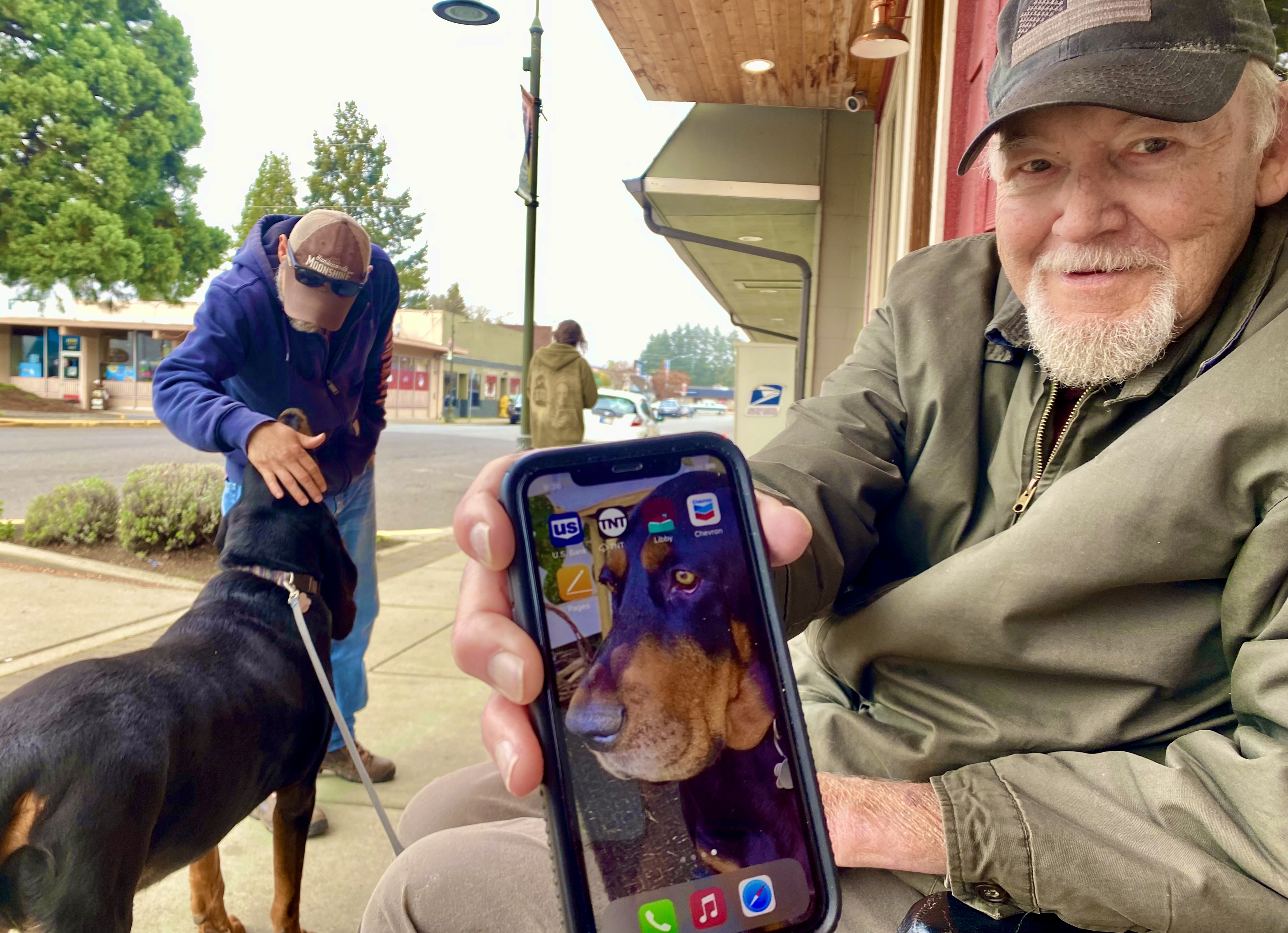
Would you like to see some photos of Walter? asks Mr.Hunt, who is as proud as a parent is of an adorable child. 

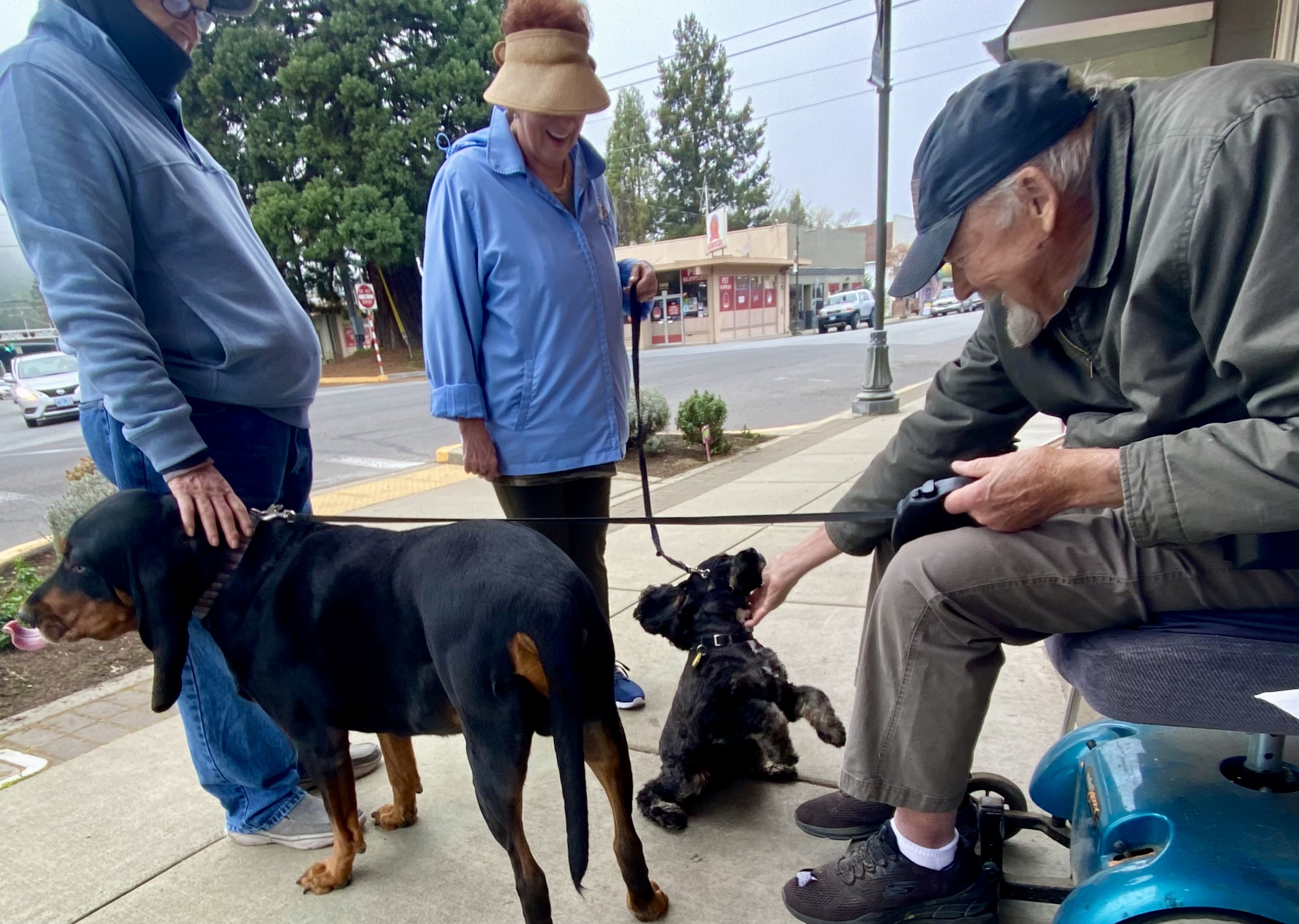
Dave Hunt, almost 83, and his pooch, Walter, practically seven, are early-morning fixtures outside Tailholt Coffee CO on Main Street in Rogue River, OR, a small town where a man and his 125-pound black and tan coonhound draw a lot of attention. 

The dog's name is Walter, and he is one lucky dog.

I’d noticed Mr. Hunt several times at his Main Street morning post, curious about him and his floppy-eared friend. Years ago, as a newspaper reporter, constantly scanning for a story, I wouldn’t have hesitated to approach him.

Decades later, as an ordinary nosy person? It took me a few months.

But one recent sunny morning, I parked my Suburu and made my way to the man and his dog, remembering how much most people enjoy positive attention. I patted the dog, smiled at the man, and inquired, “Do you have a few minutes to tell me about your furry friend?” "Sure!" he said, waving at a chair, "Have a seat!"
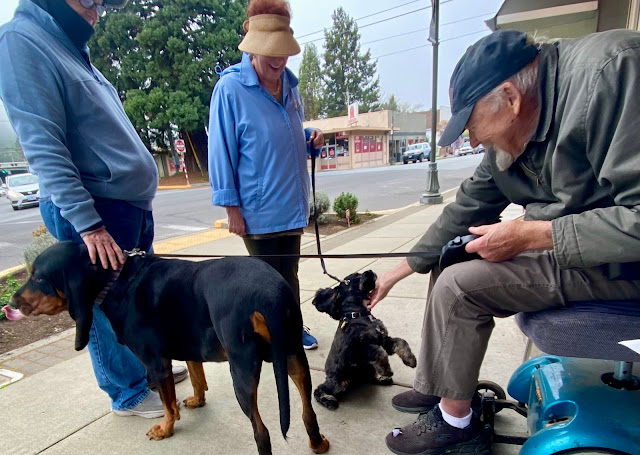
About everybody whose caffeine needs are fulfilled at Tailholt stops visiting Walter, the Tailholt Mascot, and Mr. Hunt.

I had no preconceptions about what, if any, story might emerge. But it didn't take long to think of it as a love story. It turns out that when the man and the dog “found” one another, each had a compelling need for someone to love and be loved by—a caring companion.

Later, Mr. Hunt’s landlady, Virginia, was delighted to help me unearth the tale’s beginning more than a decade ago.

She told me that Mr. Hunt moved from the Portland area to Rogue River in 2011 to be closer to family. He needed a rental, but there was a complication. It was considerable.

He’d arrived with his best girlfriend, Mona, a St. Bernard/boxer mix weighing 100 pounds.

Cautious landlords prohibit dogs, especially massive beasts, and for good reasons. But when Mr. Hunt called to inquire about the rental, he quickly disclosed he had a dog, and she was not “medium-sized.” 

"We paused a bit,” Virginia recalled. "We'd just fixed up the house, but we are dog-loving people ourselves and wanted to hear what he had to say."

And what did Mr. Hunt say? Only this:

Oh, don't worry about your house! Mona will spend most of her time on the couch!

"Right then, we knew he was our kind of person," Virginia said. "And he has been a wonderful tenant and friend through the years.” 

During the ensuing years, Mr. Hunt and Mona had a grand time making friends on their daily walks and coffee talks around town.

But as loving pet owners know well, a cherished dog’s life ends too soon. Mona died at age 13, just as her loving master, then in his late 70s, felt the aches and pains of his own decline.

"Mona was a tremendous dog," recalled Mr. Hunt. "I mourned her something terrible for months. I knew I couldn’t  live without a dog, but how could I ever replace her?"

Virginia recognized that Mr. Hunt was having a difficult time. Mourning, loneliness, and health issues were a dreadful combination.

But she and her daughter, who happens to be a local veterinarian, had their eyes peeled for a suitable companion dog for Mr. Hunt. 

Photo credit Mr. Hunt


   The  fabulous                 Walter 

    was poised

        to enter 

     Mr. Hunt's life!


Around the time that Mona ascended to dog heaven, the tall black and tan coonhound was being retired from his “job” as a show dog. He was between four and five years old and named Mr. Thorin, after a character in a Hobbit book. 

Virginia and her veterinarian daughter had put their heads together and determined that the show dog could be a good fit for Mr. Hunt. 

“Dave is used to having large dogs, and Walter had a great temperament and personality!” Virginia said.

So it was that soon-to-be-named Walter wagged his way into Mr. Hunt's life.

“Virginia and her husband, Paul, took me to meet the dog, and Walter came home with me the same evening,” recalls Mr. Hunt. 
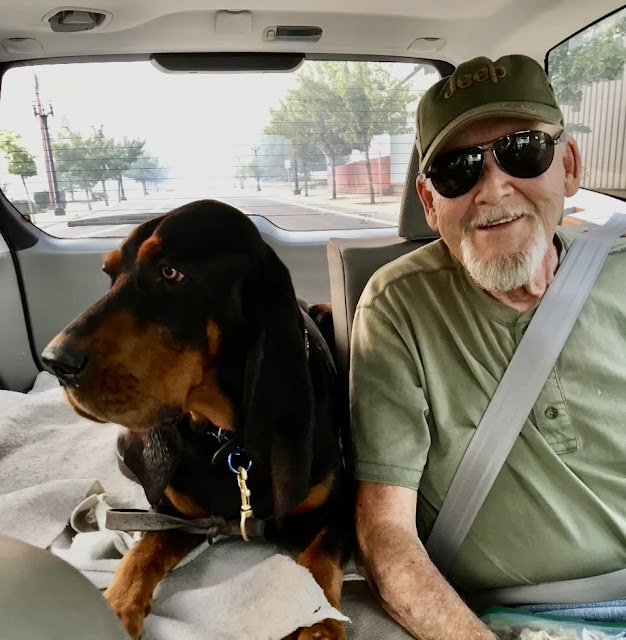

Walter made it clear during his "homecoming" that he hated riding in a vehicle, something he’d often had to do for dog shows. The ride to Mr. Hunt’s home was his last time in a car!

Photo courtesy of Mr. Hunt


Walter required about a week to adapt to Mr. Hunt, who also had some adjustments. 

“The hardest part was getting Walter to understand that his bed was a double recliner, just like mine,” he said. “He was quiet and shy and wasn’t used to having someone urge him to get up on the furniture!”
 
Walter's double recliner is behind him, with Mr. Hunt's identical recliner along the adjacent wall. During my afternoon visit, the dog kept a close watch on his master, staring at him most of the time. 


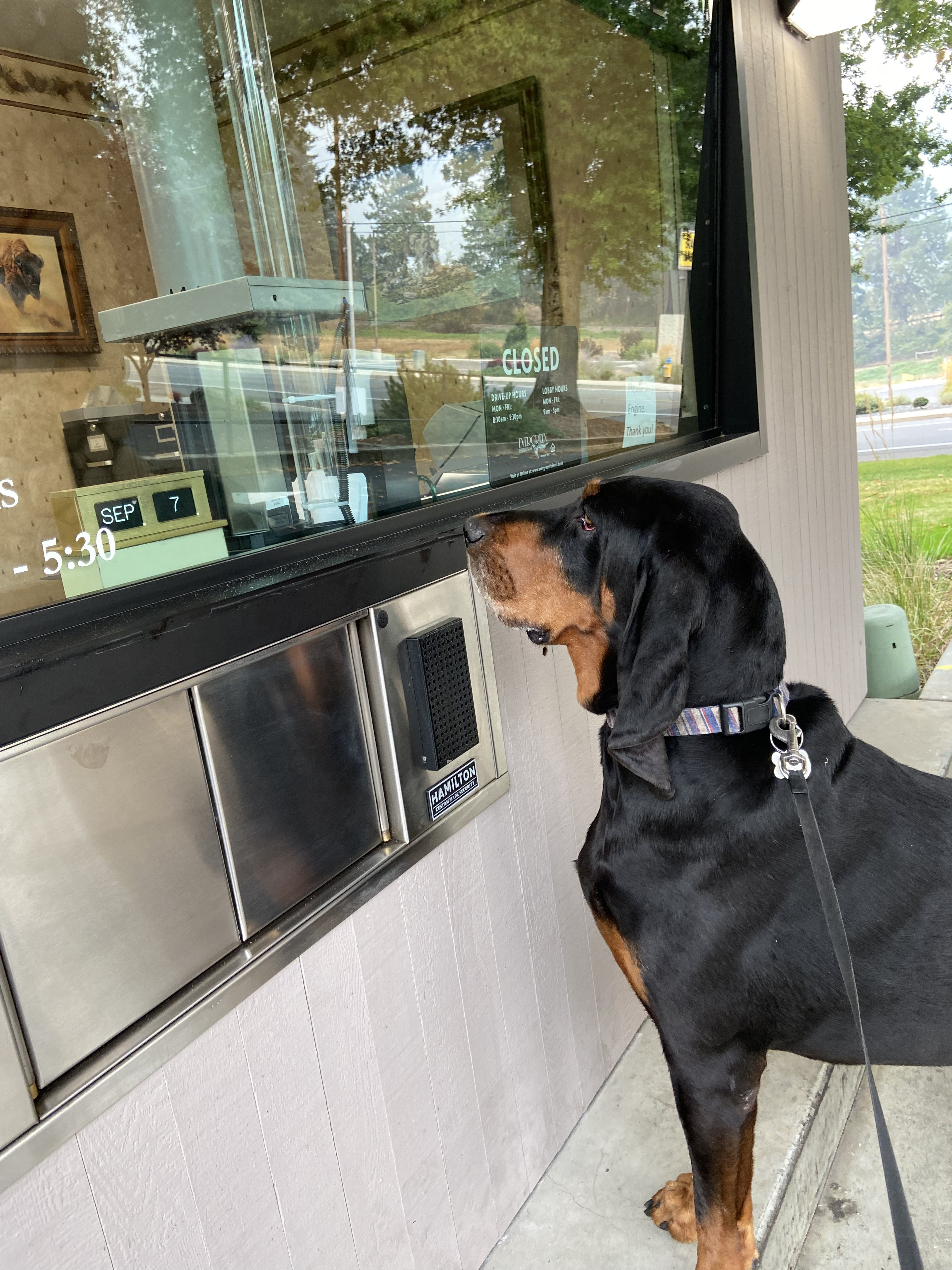
While Walter and Mr. Hunt are best known for their early morning Tailholt presence, they also enjoy daily afternoon forays. Gas stations, Lil’ Pantry, the Dollar Store, and sometimes the Rogue River Pharmacy and Evergreen Bank are on their itinerary.

Sometimes, with Mr. Hunt's assistance, Walter has trained people at each stop to provide treats

Walter awaits a withdrawal from his biscuit account at Evergreen
bank in Rogue River, where  Mr. Hunt ensures he always has a balance.
,

The dog is Mr. Hunt's reason to get out of bed in the morning and away from the house at least twice a day, breathe fresh air, and have fun. 


            I accidentally caught Mr. Hunt on his motorized scooter 
with Walter towing him. All the places they
 visit in a day are within six blocks of home.

 “Walter is my link to other humans,” Mr. Hunt says. “He takes well to most people and is a conversation starter. He’s also a chick magnet.” (Wink, wink.)

But unpleasant realities loom on the horizon.

Walter will be seven in July. His breed’s lifespan is 9 to 13 years. Mr. Hunt will be 83 soon, but his lifespan could reach 100.

His daughter recently suggested that her father moves into assisted living housing, where he would be safe and all his needs addressed.

“No way!” exclaims Mr. Hunt, who went online (he’s quite the computer guy) to research the topic and found information supporting his independent stance. 

17 Signs It’s Time for Senior Assisted Living

But the reason for "no assisted living" that matters most? Dogs are not allowed.

“How could I live without that dog, and what would  Walter do without me?”   

Good question. 

Mr. Hunt was enthused that morning as we visited outside Tailholt Coffee CO: Dogs are a joy! They are such wonderful companions! 

Honestly, he was almost breathless as he leaned across the small table outside the coffee shop. 

Juicy jowls aside, this is a dog's "look of love."
Photo credit, Mr. Hunt

“Dogs look you in the eyes, and you know they love you,” he continued. "And you know you love them."

At a particular time in life, and in a festering world somehow hoping that "every little thing's, gonna be alright," What else matters but loving relationships? 

And loyal pets and their devoted humans create tender emotional bonds daily.

Mr. Hunt is delighted by this quote:

Until one has loved an animal, a part of one’s soul remains unawakened.—Anatole France
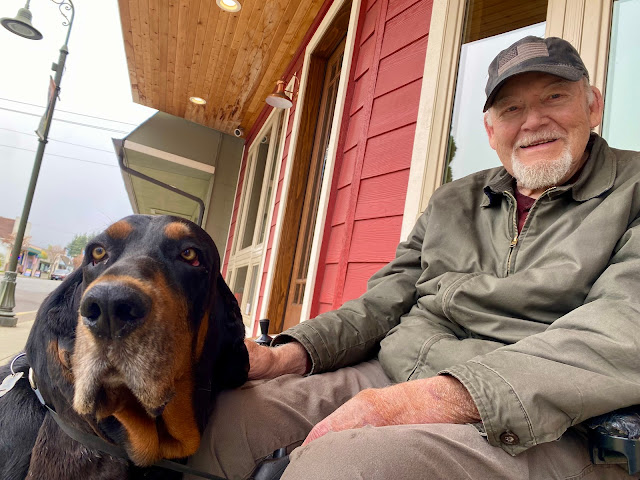
Here's a man with an awakened soul and the dog he loves.
Give em' a hand.

Wednesday, January 26, 2022

Story about a nice person - We must look out for each other


I shot this photo in Guatemala, a ruggedly beautiful country. Sadly, my photography affliction didn't kick in during the short time I was "in trouble" there and being rescued.  Words alone will have to suffice.

Some travel stories are meant to be shared. Others, not so much. I've tucked this one into my back pocket. Lately, it's been agitating to come out of hiding, so here we go. The episode transpired in Guatemala on February 4, 2020, about a month before COVID 19 shut down borders worldwide.

I was en route to Adopt-a-Village In  Guatemala's remote Maya Jaguar school campus to shoot photos as a volunteer, and at the same time, get a deep look at an organization PK, and I have supported for years. I was honored to be traveling with Frances Dixon, AAV's founder, and president, for 30-some years.

That day, what happened to me was a quick but disconcerting example of what not to do as a stranger traveling in a foreign country, especially if the local language eludes you. 

On the bright side, it resulted in a stellar example of a stranger going out of his way to aid another human—me. Two years later, I still think about this guy. And how to be more like him.

Before I get ahead of myself...I was one of two front-seat passengers in a Toyota 4WD pickup headed to the Maya Jaguar campus. The journey from the international airport in Guatemala City requires three long but scenic and culturally rich days, mostly while bumping along on eroding roads and over sometimes questionable bridges. Thankfully our driver, Juan, possessed the skills to conquer Third World navigation. 

Although Juan was accustomed to the three-day route, this trip also required dropping into Quetzaltenango, a city of nearly a million, to check on a recent Maya Jaguar graduate, Isabela, who was enrolled at a computer skills school there.

Guatemalans in colorful everyday dress overlooking the valley occupied by the country's second-largest city, Quetzaltenango. (Not my photo.)

Like all Maya Jaguar students, Isabela was born in a remote village, raised on dirt floors, gathered firewood for cooking and heating, carried water, and got by on a diet of beans and corn tortillas. She was destined for teenage motherhood and a lifetime of hardships.

Instead, she was among the fortunate young people in Guatemala's remote and impoverished northwest corner whose lives have been, and are being,  transformed through rigorous education at AAV. 

Still, Isabela had never set foot in a teeming city, let alone been on her own. Also, she was the computer school's only female student. Frances, who loves her students, was a tad worried and eager to see how a former star pupil was faring. The two made arrangements to reunite at the computer school.

Frances had the school's address but...no directions.
No maps. I possessed a device to save the day, an iPhone with a Google maps app. Hooray!

I typed in the school's name, and in seconds, Google produced what it does for flummoxed way-finders practically anywhere—laid out a crisp route and offered audio directions. 

Juan, who'd never used such a tool, was giddy. Especially with the audio feature. So. Into the city's bulging belly, we plunged in high spirits.

We didn't have to go far to reach the address. But there was a problem—the school was not there. Juan and Frances consulted strangers who pointed down the traffic-clogged street, saying the school was three blocks away.  

Frances and Juan settled back into the truck. Having been sandwiched between them for several squished hours already, I decided to walk those three blocks.

"I'll see you down there!" I exclaimed cheerfully as I strode off alone, confident that I would locate the school because, you know, it was thereI waved at my companions as they passed, pleased to be on my own. 

That didn't last long. FIVE blocks later, I was still searching. It must be in plain sight, I thought. Hoped. Who can't spot a school, for Pete's sake!  

I couldn't. I looked for a school-like building, something proud, made of bricks, with a sign in front and students congregating. 

And so I threaded through dense crowds—hundreds (thousands?) of people. Block by block, slowly. Scanning both sides of the street for anything school-like. Nada.

My buoyant mood dissolved, and I wondered if my brain would be involved in that process as well.

And where was the Toyota truck? They stick out like crazy in a part of the world where such a valuable vehicle is scarce, coveted, and hard to miss.

No truck. No obvious school. HMMM. 

Unprepared, I'd grabbed my phone for a short solo journey but nothing else. The temperature felt to be in the 80s, and the sun was brutal. I had no hat, no sunscreen, no water, no money, no ID. And my pathetic Spanish language skills were useless. (I could've used a translation app on my phone but didn't think of it.)

About a half-hour had transpired. My companions would be looking for me at some point. But I couldn't duck into the shade for fear they'd miss me.

As far as they knew, I was a capable adult. A seasoned traveler. The last thing I wanted was to be a stinking burden, some tender know-nothing,  requiring constant attention, let alone rescue!  

I staked out my alarmed self on a 4-way intersection with sharp visibility from all directions—a tall, pale flower wilting in the sun, craning her skinny old neck this way and that above a sea of curious brown faces. 

In the meantime, Frances, bless her heart, was joyfully reunited with Isabela at the school, which was, as we'd been advised, precisely three blocks from where we'd started. Juan hadn't located a parking spot and was waiting elsewhere for a signal from Frances. 

By then, I'd been "lost" for (guessing here) 40 minutes. I was sweating, thirsty, and concerned. Embarrassed. To say the least.

Suddenly a car materialized beside me, alarmingly close. The driver, a young Caucasian man, shouted over traffic clamor, "Do you need help!?"

Holy moly! Yes!!

He stretched to open the passenger door and urged me to get in! I saw he needed to move with the traffic. So. OMG. I vaulted into this stranger's car, and off we inched. 

But not far. He wasn't nefarious but decent, kind, honorable, and confident. He parked near the school, which was hiding on the second story of an unremarkable building with another enterprise on the ground floor facing the street. The school's modest signage was hidden on the side of the building.
No wonder I didn't see it. 

"Why did you stop for me?" I asked in wonder.

"You looked lost and worried," he said. "I drove around the block to see if I could help."

He was a South Carolina missionary, and said he was a "shepherd." That worked for me.

I was a sheep in obvious distress, an older white ewe searching the cityscape with frantic eyes. I told him my embarrassing I-could-not-find-the-school story.

He quickly located the school's phone number and called to ask if Frances was there with Isabela. She was.

Flooded with relief, I realized I had been rescued by perhaps the ONLY person in the city who could have come to my aid. What incredible serendipity! And luck.

Had he not stopped, Frances and Juan would have located me. Eventually. But I was so grateful they didn't have to do that. We were only a couple days into our time together, and I was spared from a possible ball-and-chain designation. Whew!

I asked the Shepard why he made this considerable effort for a stranger.   

He didn't hesitate—We all need to look out for each other.

With that, I leaned over and threw my arms around his young neck, tearfully thanking him for saving the day. I didn't get his name. 
 
Maybe Gabriel?

He delivered me to the school, and I sprinted to the second story, where Frances was starting to wonder about me.

And I was beginning to have a good time watching her and Isabela as they reminisced (in Espanol), with evident caring for one another. I've known Frances for about 10+ years. She LOVES her students and has a deep respect for Maya. You can see the pride and satisfaction in her eyes, below. 

Frances and Isabela shared proud moments as they reunited
at the computer school. Isabela demonstrated that she was 
succeeding in post-graduate work and was deftly
navigating life in a huge city. Two years later, this young
woman is the computer instructor
 at the Maya Jaguar school. 

I happily snapped photos, making light of my tardy entrance. But thinking, at the same time, that what the young missionary did for me, Frances does every day, for Maya youth to whom she's devoted her life since the 1990s. 

Thanks to the missionary, to Frances, and all humans who exemplify kindness, caring, and generosity for others. And go out of their way to do it.

Me? I am humbly attempting to be one of them.


An earlier Ordinary Life post about my life-shifting time in Guatemala -


A post I wrote for the Adopt-a-Village in Guatemala website - 
Moved by a Mission 


Monday, July 26, 2021

Surprise and Inspiration in Guatemala


     I spent a brain-bending and heart-shaking couple of weeks in prepandemic NW Guatemala, February 2020, at the Maya Jaguar Educational Center (MJ). The school is an outreach of Adopt-a-Village in Guatemala (AAV). This singular organization has a dizzying but beautiful vision of restoring the Maya to self-sufficiency and self-respect through excellent education and health-giving nutrition. My time there was at once fascinating, frustrating, frightening, fun, and inspirational. 


Where is the Adopt-A-Village school?


The campus crowns a mountaintop in remote and rugged NW Guatemala an hour from the nearest village—and three full travel days from the airport in Guatemala City. It is close to the Mexican border. This aerial view includes some of the 200 acres of pristine rainforest upon which the campus has evolved for over three decades. Pristine because Founder/President Frances Dixon fenced the property and installed a locked gate at the only entry, saving the rainforest from the fate of the surrounding area where coffee plantations, cardamom fields, and wood gathering have all but destroyed the natural landscape.  

She wanted students to learn in a natural environment filled with bird songs and rainforest fragrances. Classrooms and administration buildings are on the right side of the photo, along with teachers' cabins. On the left, boys' cabins, the girls' dorm, a cafeteria/kitchen, numerous raised-bed gardens, rainwater collection tanks, outhouses, greenhouses, and a coop with 50-some chickens. 


The school's prized Toyota 4WD pick-up works as hard as any student. A driver picks up students at meeting points on roads to deliver them to the campus, where they will study for 18 consecutive days before going back to their villages for 10-12 days. In the meantime, the truck is in continuous use doing necessary bumpy and long trips to school and village operations. The truck must be replaced every two years!

Education on the Mountain

 Learning is a life-altering practice at Maya Jaguar (MJ). Although having a visitor on campus is unusual, students paid rapt attention to their biology teacher. These are older students who accept that the work they're doing in two years requires four years in public schools.

MJ's curriculum significantly surpasses educational standards established by the Guatemalan government. Regardless, these teens are committed to an education that can deliver them from poverty and servitude. So far, graduates have become nurses, teachers, and computer experts, rather than life-long field workers and 14-year-old mothers. 

 This group may look rowdy, but it's not. I was a wacky stranger encouraging     them to smile and wave for the camera as they arrived on campus for 18 days.   

Eighteen consecutive days!? Yes. Then back for 10-12 days in villages helping their parents, who initially were reluctant to release their hard-working teens for days on end. A compromise was reached; students are released to study 18 days (without a break) at MJ then return to their often distant (between a one-hour and 10-hour drive) to help the family in the coffee and cardamom fields, fetch water, gather wood, tend cooking fires, watch younger children. On and on it goes. Endless work. The same is true at the school, except the focus is on academics, plus a couple hours of chores. They rise at 5:30 a.m. and lights out at 10 p.m. 

You'd never know that the Maya Jaguar students were (or had been) disadvantaged. If I could make but one remark about the school's boarding students? 

They are the hardest-working teenagers I've ever met and the most cheerful, polite, and unjaded. And well-groomed.

Vidalia Marli Ortiz Domingo is one of them. She's wearing red in the photo below. PK and I help sponsor her education. Click here for information about donating or sponsoring.

This was Vidalia's first day at school and may have been the first time she'd slept in a sturdy building with wooden floors, flush toilets, and sinks with running water just down the hall. The dorm also has limited generator-produced electricity, but lights are on until 10 during evening study time in a commons room. Each student is supplied a solar-powered flashlight if further illumination is required. 

Vidalia and I had commonalities. Neither of us wore the traditional colorful embroidered Guatemalan clothing sported by the two other girls pictured. Me? I wore standard USA jeans and a T-shirt covered by a shawl. Plus, my usual hide-horrible-hair bandana. Vidalia wore used clothing, a boy's shirt, a plain navy skirt, and ragged ill-fitting flip-flops. She wore the same things every day. Not that any student arrived with a bag crammed with outfits. 

Other things in common? The day we arrived on campus was the first either of us had seen what is officially called the Maya Education and Developmental Center, a place I'd envisioned and longed to visit during years of volunteering for AAV.

Also, we both sucked at speaking Spanish. 

Vidalia is a native of Guatemala, a Latin American country, and she can't speak Spanish? Well, no. As a U.S. citizen attending public schools, I had more opportunities than she did to learn Spanish. Which I neglected to do, much to my regret. 

Why was Vidalia, or any other Maya youth entering the school, unable to speak the national language?

Like all the school's students, Vidalia grew up in a village speaking only Mam, one of three Mayan dialects in the area. The free public schools available to villagers do not teach the Spanish language, and teachers, by all accounts, rarely show up. Few Maya children make it through sixth grade. If they do, families must pay for mandatory school uniforms for junior and high school, which is out of the question. So Maya kids are done with any hope of schooling past age 12. Into the fields, they go. And for too many girls, on to early childbearing. Most drop out by grade three.


Learning Spanish is the first order of business and Vidalia looks as perplexed as the other newbies experiencing their initial Spanish language lesson. All classes are taught in Spanish. Talk about immersion!

It turns out that Vidalia was fortunate to be at MJ at all. Her family, more destitute than most, was in crisis. Her father had been forced off a small plot of land he believed he'd purchased with a handshake years ago. Handshake deals are common in villages where illiteracy is rampant. With scant notice, his impoverished family, including three children, was forced to vacate. He pleaded with AAV founder and president Frances Dixon to delay Vidalia's school start so the girl could help the family relocate. 

Frances said absolutely not. Not much trumps a child's needs in her view, especially a girl's urgency to be present on her first day of a real education. Frances will go off big time on the fate of uneducated indigenous females, including early childbearing, domestic violence, and life-long servitude. She's seen it all.

But Frances has a great big heart. Instead, she arranged temporary help for the family. Vidalia arrived with other students in time for her first day which included three nutritious meals packed with veggies, beans, and flavor.

           Food Matters on the Mountain

Every meal at MJ is a nutritional powerhouse. Everything on the plate was grown on campus or AAV's Educational Farm two hours distant. Every meal is homemade, and each vegetable is chopped by students during their 6 a.m. rotating chores. Every morsel is eaten, as I learned the hard way when I was late to dinner. Once.


The nutrient-packed meals are integral to AAV's mission. According to UNESCO and USAID, the Huehuetenango Department (state), where AAV is located, is the sixth-worst in the world for chronic child malnutrition, with 70 percent of young children stunted and malnourished in many villages. AAV is changing that statistic, which likely worsened during
the pandemic and the terrible storms and floods of 2020.


Below, Frances consults with master gardener Pasqual and driver Juan, not far from student housing. The raised beds and greenhouses are interspersed with boys' cabins and the girl's dorm. Every student is engaged in organic gardening.

A certificate of Organic Gardening is awarded to graduates, in addition to an academic diploma and a certificate of computer science. Perhaps best of all, students carry horticultural knowledge back to their home villages where gardens are becoming the norm. (Adult villagers may also benefit from gardening instruction at AAV's Educational Farm.)


A gardener myself, I was delighted to see all this cultivation and witness students caring for plants, including a young man using his solar flashlight to weed tomatoes around sunrise one morning. All students perform chores daily, including the hour between 6 a.m. and 7 a.m. No sleeping in for these teens.


Washing your own dishes after a meal and then returning them to the kitchen to dry is just what you do. See Vidalia learning the ropes?  A cook employee takes responsibility for the large pots required to feed 50+ people, but students are assigned to other kitchen chores, including cleaning. These are but three of 40 rainwater tanks on campus. 


Please click the link and enjoy.


         Next up - Mountain education thrives during the Pandemic. Visiting Vidalia.